

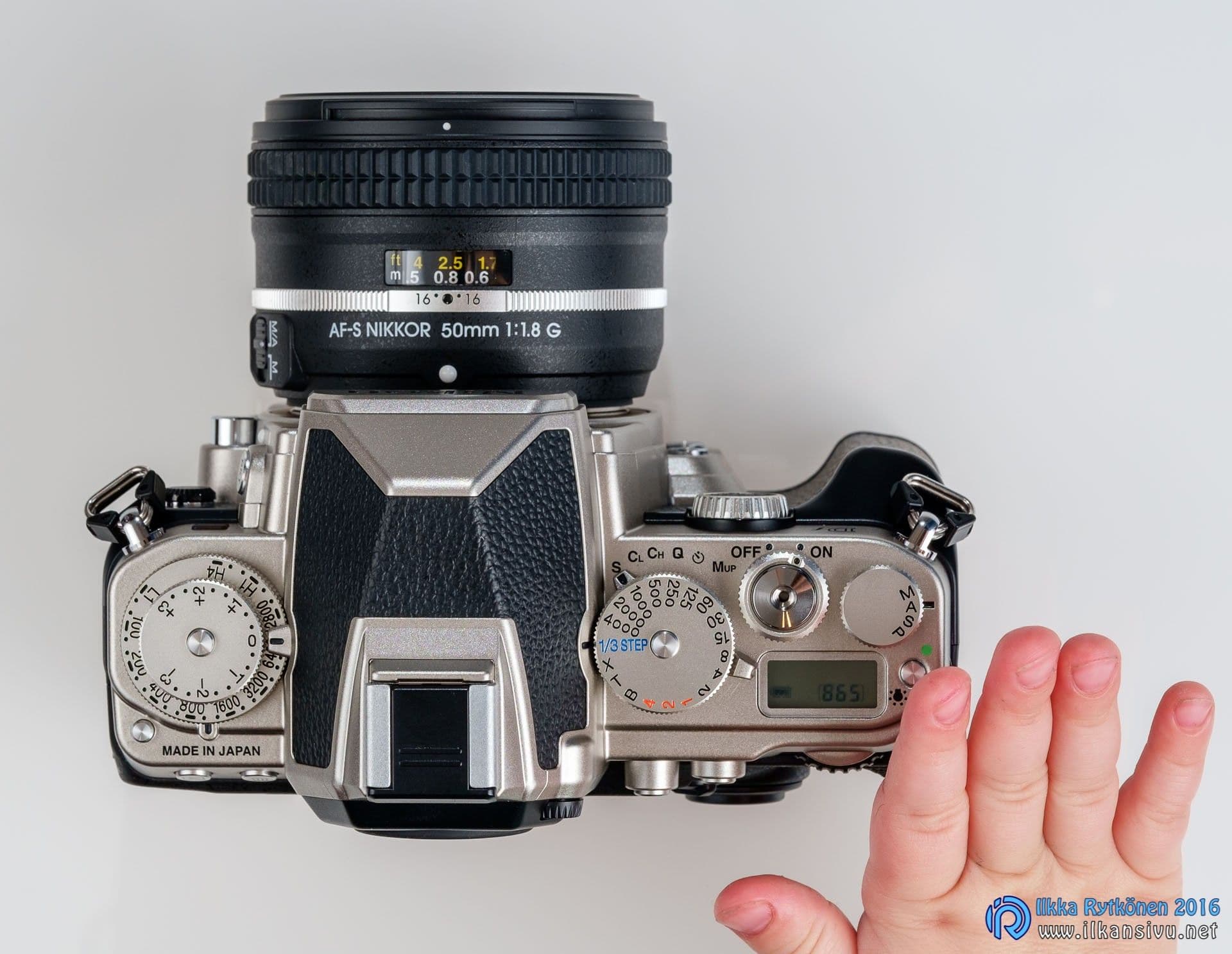
Modern technology in a retro body
Nikon introduced its F model already in the 1950s and a couple of years ago brought a digitized retro version of that model to market, called the Df. The camera under test is thus not exactly a fresh novelty, but it is still on sale.
The Nikon Df imitates its predecessor in many respects, but the film advance lever has at least been left out.
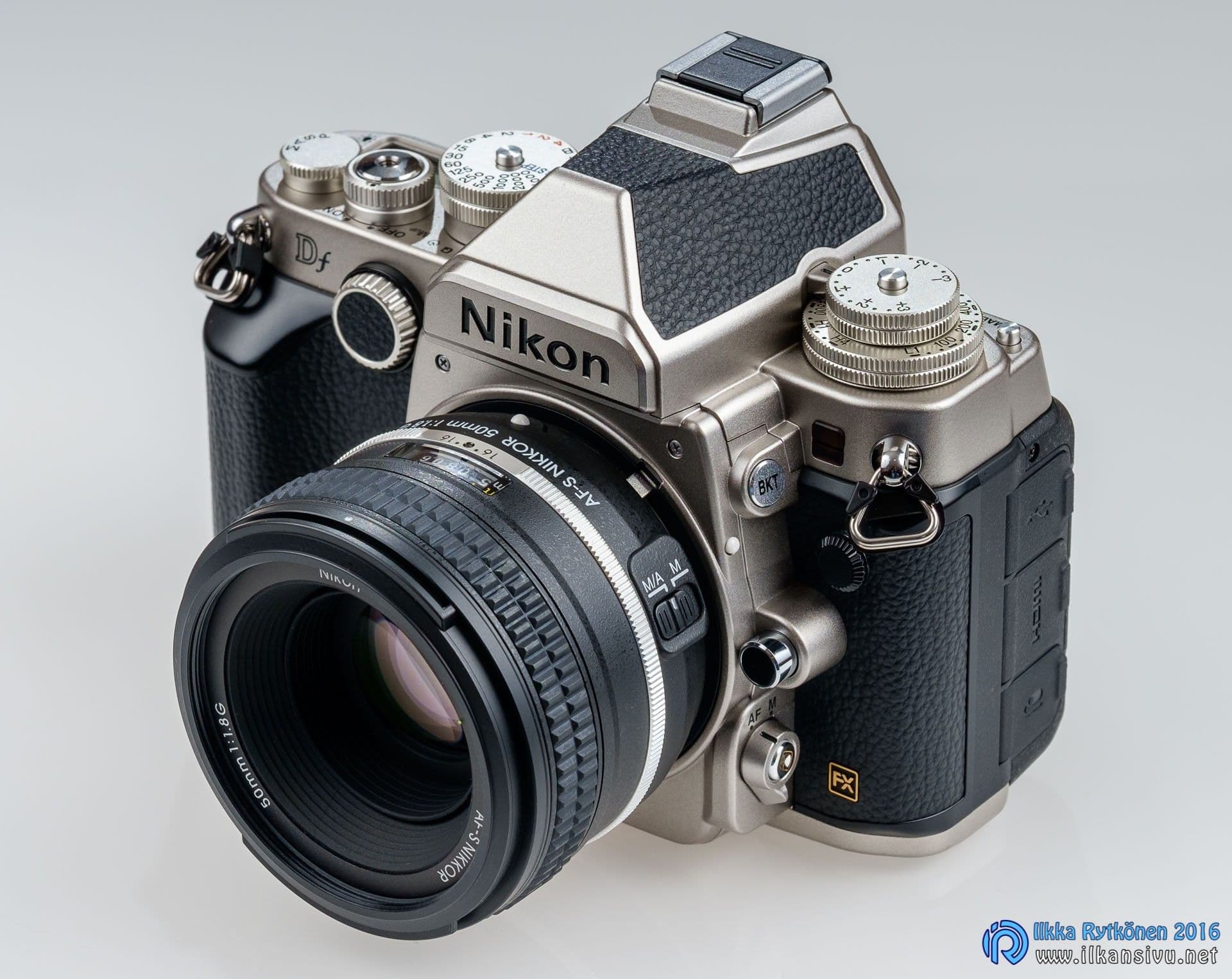
The Nikon Df imitates its predecessor in many respects, but the film advance lever has at least been left out. The body is full of separate controls, so almost everything can be adjusted directly without going into the menus. The viewfinder shows 100 % coverage at 0,7x magnification, so it is of a good level for a mirror camera.
There are separate dials for shutter speed, ISO sensitivity, exposure compensation, bracketing and metering. The usual front and rear command dials are also found in their own places. The front dial, however, is now vertical. There are no automatic shooting modes.
The camera follows its predecessor to the extent that no video shooting is offered.
The camera follows its predecessor to the extent that no video shooting is offered. Live view is there, so adding video would not in itself have required any miracles. The body also has no built-in flash or Wi-Fi.
The Nikon Df is sold as a body only or with the Nikkor AF-S 50mm f/1.8G Special Edition lens. The lens is the same as the standard version, but its styling suits the Df better.
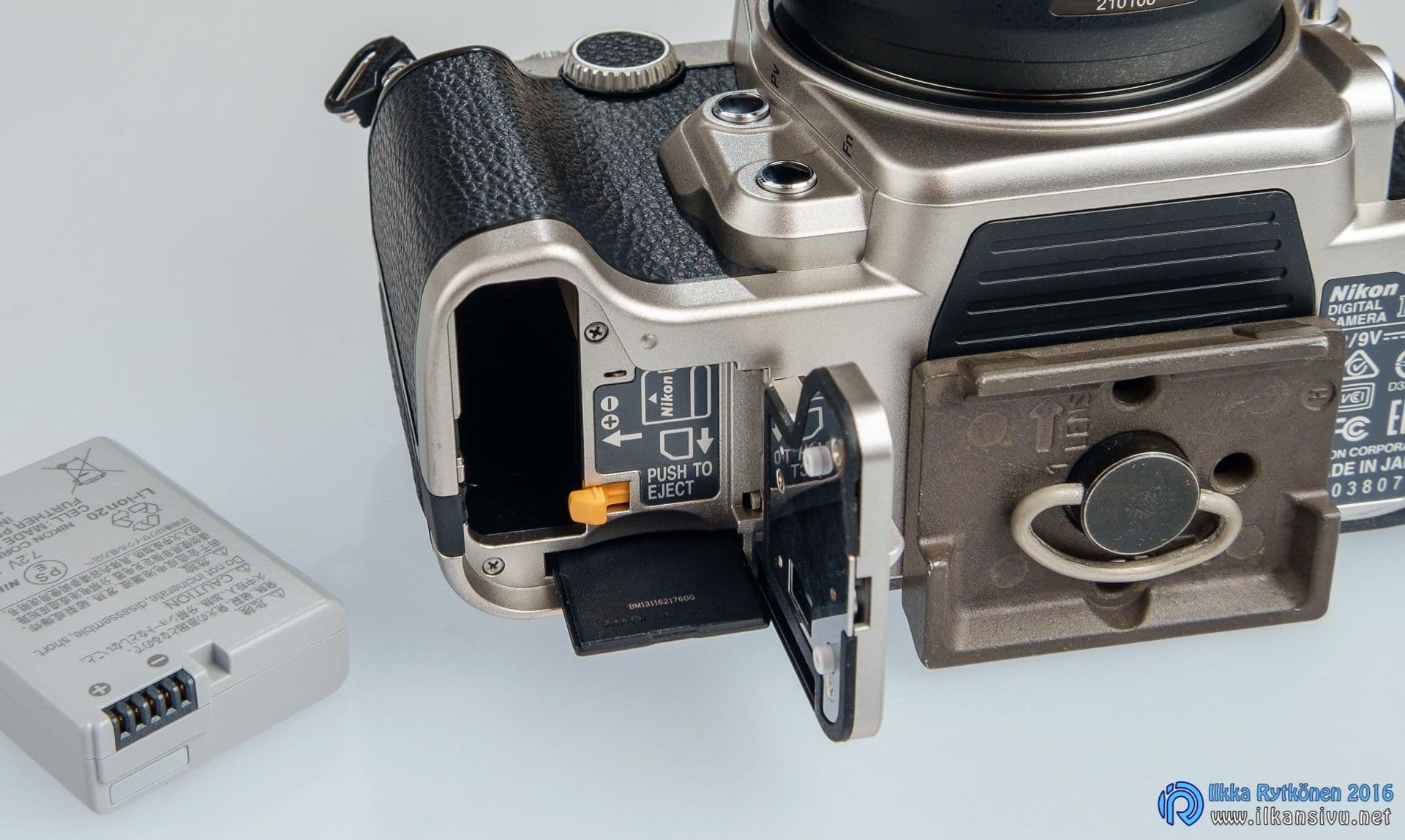
The sensor is the same 16-megapixel full-frame CMOS as in the professional D4. There are 39 focus points, 9 of which are cross-type. There is one memory card slot, which takes SD/HC/XC cards. The battery is, surprisingly, the small EN-EL14a, not the EN-EL15 used in the other Nikons of this type.
In addition to the FX lenses designed for full frame, the camera can also use DX lenses designed for the smaller sensor. When these are used, only the central part of the sensor is used, so the pixel count drops to about half of the original.
The camera is available in black as well as silver. My own favorite color during the test has been silver, which goes extremely well with the retro style.
Feel
If you are a Nikon user, you surely know how the manufacturer's cameras feel. In pictures the Df looks sturdy, but picking it up brings a slight bewilderment. The grip is surprisingly small relative to the size of the body.
The other controls, too, feel stiff and slightly cumbersome to use after modern cameras. The PASM switch has to be lifted so that it turns to another position, and many other controls also demand a little more attention than usual when changing settings. Switching the power on takes two fingers instead of the usual one.
The supplied battery charger is awkward, because it plugs directly into the wall socket. That way it also takes over the neighboring socket. The good thing is that a separate battery charger comes with the camera at all. That is not a given these days.
When shooting
After you have shot with the camera for a while, all the controls and their logic start to feel better. And the more you shoot, the better everything feels.
The more you shoot, the better everything feels. The initial stiffness thus turns into fluency in practical shooting.
The initial stiffness thus turns into fluency in practical shooting. But the grip could certainly be bigger for a large hand. On the other hand, the hand settles on the grip so that the index finger rests nicely on the shutter release. With gloves on, the feel of the buttons tends to disappear, so you gladly take them off while handling the controls.
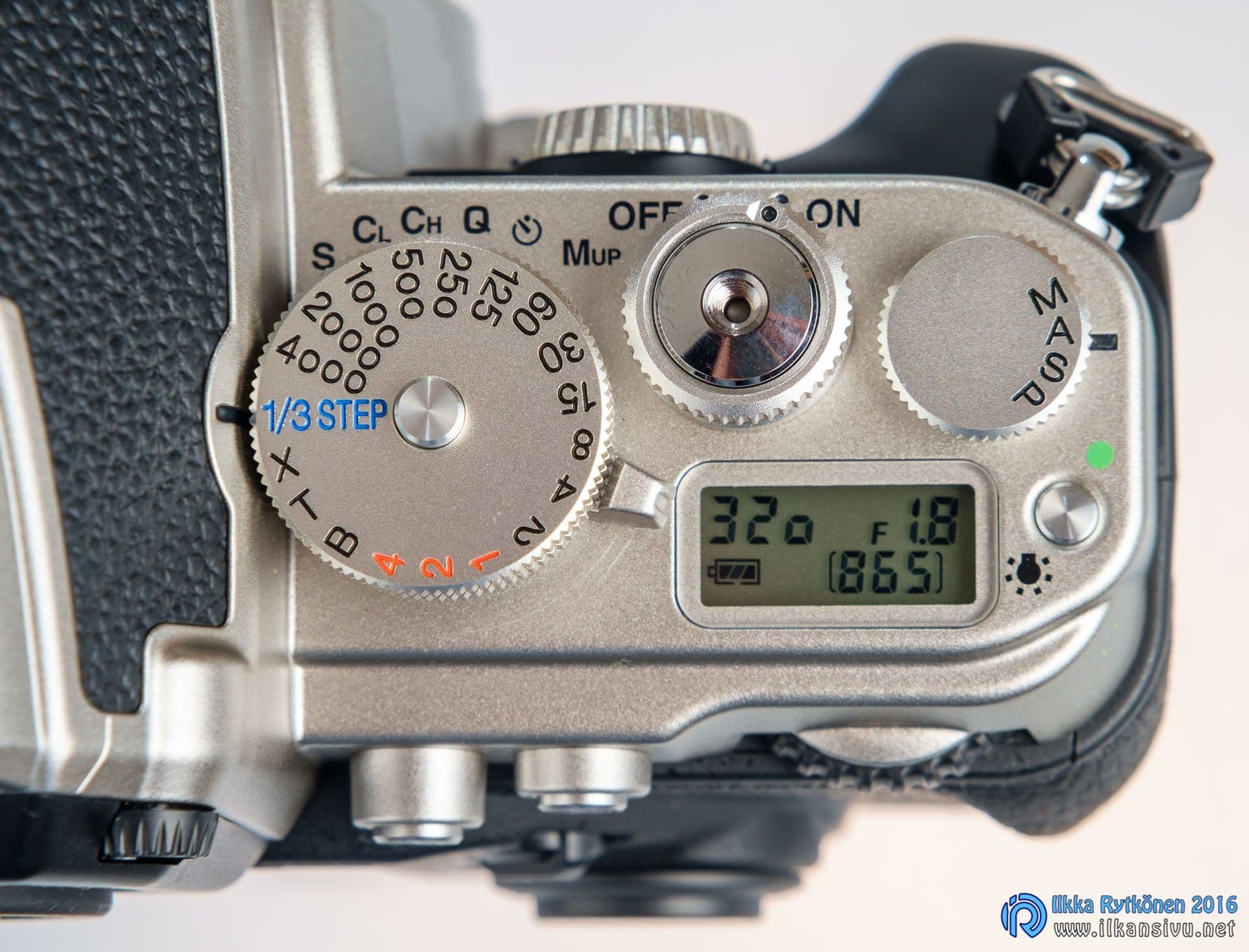
The shutter speed can be selected either with the shutter speed dial or with the rear command dial. When using the shutter speed dial, only full EV steps are available, and intermediate values cannot be selected with the rear dial. If you want to adjust the time in 1/3 steps, you have to select the 1/3 step position on the shutter speed dial, after which the controls work like on a modern camera. That is, shutter speed with the rear dial and aperture with the front dial. A flash photographer can select the fastest flash sync speed from the shutter speed dial with the X position.
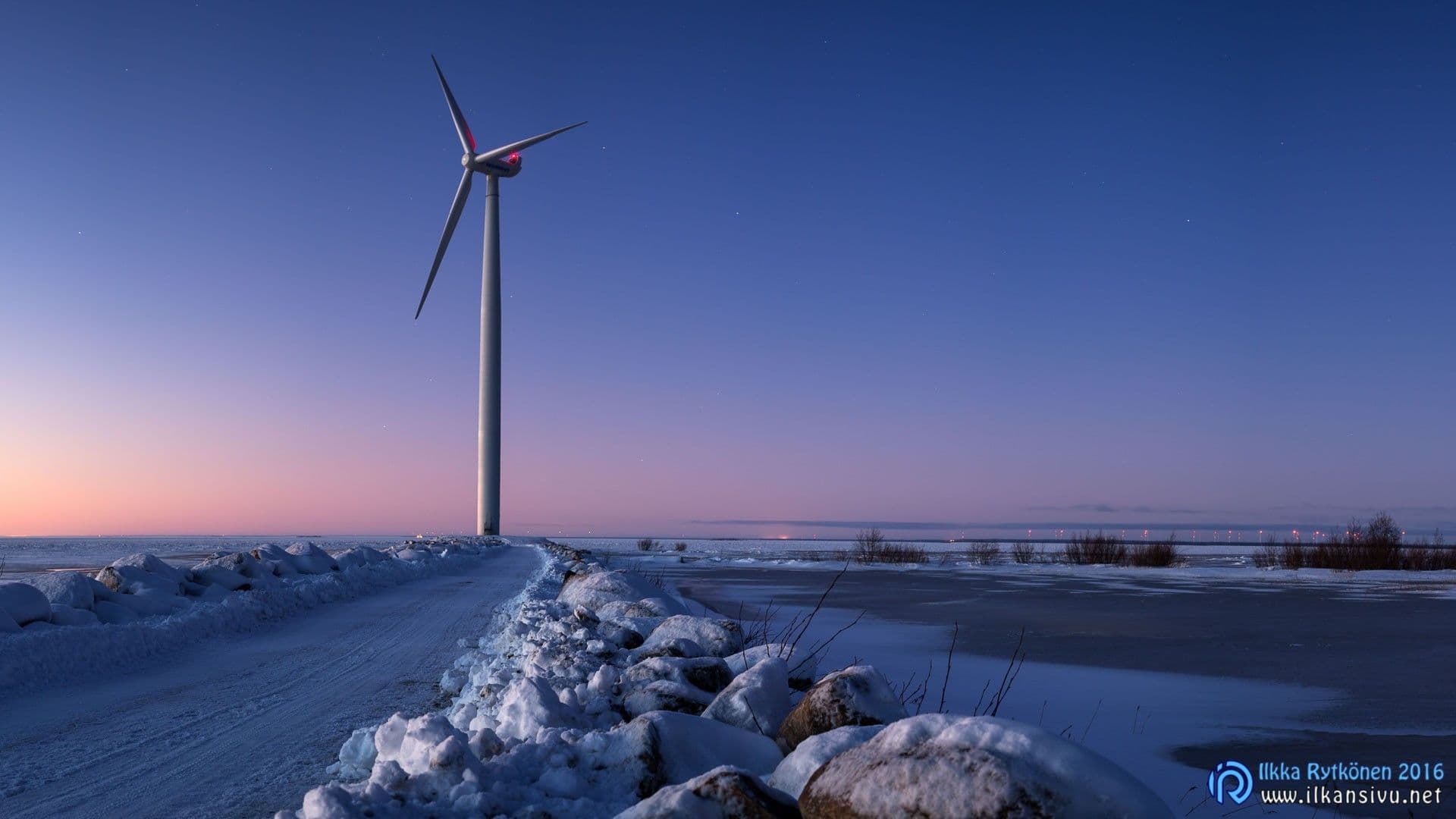
Autofocus is not quite at its best in dimmer light. In some situations focus may fail to be found even though there seems to be good contrast under the point. A night landscape photographer has to carry some kind of assist light to get the focus working. In better light the focus is quick.
The focus points are placed rather center-weighted, as in practically all full-frame mirror cameras. The focus settings are similar to those in other Nikons as well. The praised 3D tracking is also included. Selecting the focus point works directly with the button on the back without intermediate steps. This is exactly how it should work in this respect.
Matrix metering works mostly splendidly, and in basic situations at least there is no great need for exposure compensation. The lock on the exposure compensation dial makes using it a little harder, so working exposure metering is a good thing. And when shooting raw, small and somewhat larger corrections are possible.
Automatic white balance works well, and there was no need for manual settings. However, if you shoot jpg files, then I would for safety's sake use a manually selected white balance, just to be on the safe side.
Although the battery is smaller than in Nikon's other full-frame cameras, battery life seems to be at a good level. The test shoots never ended because of a lack of power.
The LCD on the top is very small and minimal. It shows the shutter speed, aperture, number of remaining shots and battery charge. When the shutter is pressed halfway, the display shows the number of shots that fit in the buffer memory.
Personally I like cameras that have a separate LCD for making and showing settings. Then the rear display can stay off and not disturb. Because of the limitations of the small top display, the rear display too has to be used as an aid in making settings. This, however, works as well as it possibly can. That is, the rear display knows to light up for, say, selecting the focus mode, but turns off right after the adjustment.
The ISO dial has no automatic option, so auto-ISO has to be switched on separately from the depths of the menus. In this respect other Nikons are much easier, where changing this setting is really easy. Fortunately there are a couple of customizable buttons next to the lens mount, to which automatic sensitivity control can be assigned if desired.
The shutter sound is moderately subdued, and on that account the camera can be used to shoot, for example, in a church without disturbing the ceremony. A quiet mode is also available, but in practice its effect is nonexistent. In quiet mode the mirror returns to its original position only when you release the shutter button.

As in other Nikons, here too you cannot use the self-timer and mirror lock-up at the same time.
As in other Nikons, here too you cannot use the self-timer and mirror lock-up at the same time. So a tripod photographer has to carry a suitable remote release to prevent vibration. For example, in Canons it is possible to enable a 2 or 10 second delay together with mirror lock-up, so a remote release is then not a mandatory accessory. In a few newer Canons there are even more delay settings.
The viewfinder has no fixed eyepiece shield, but a detachable one comes in the sales package.
The camera's image quality
At base sensitivities the image quality is at a very good level. It is worth raising the sensitivity boldly, and I myself would at least be ready to use as high as ISO 12800. In a pinch ISO 25600 is still passable. Higher sensitivities I would use only when forced.
It is worth raising the sensitivity boldly, and I myself would at least be ready to use as high as ISO 12800.
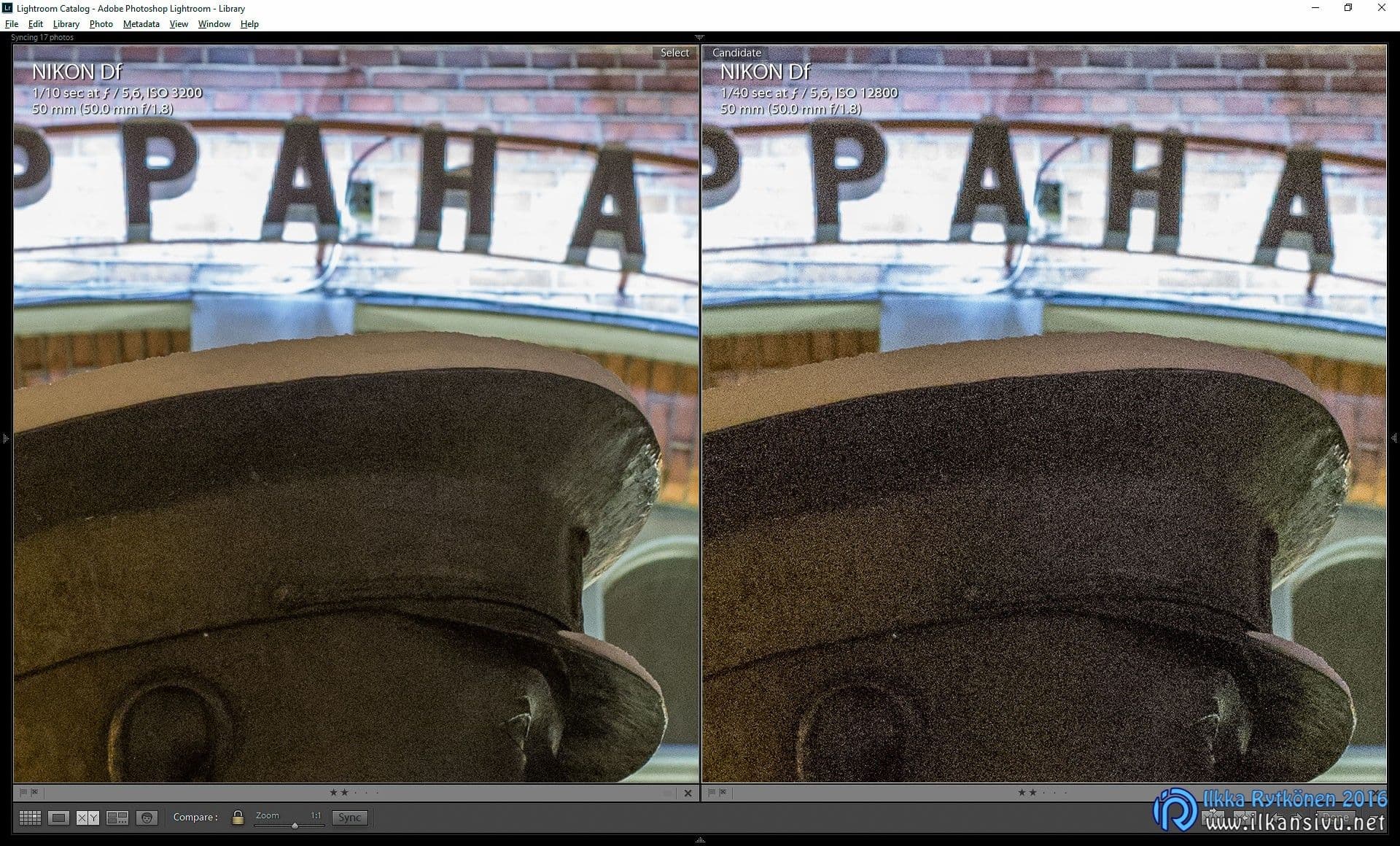
The dynamic range cannot compete with newer full-frame Nikons, but it is still quite decent. On the other hand, raising the sensitivity evens out the differences in dynamic range between brands and models significantly. Up to around ISO 3200 things are still at a quite reasonable level, where tones can still be dug out of the dark areas reasonably. The light tones stay under control up to ISO 12800, and after that the possibility of rescuing tones weakens essentially. But no wonder, which is why correct exposure is important at high sensitivities.
Nikon Df dynamic range
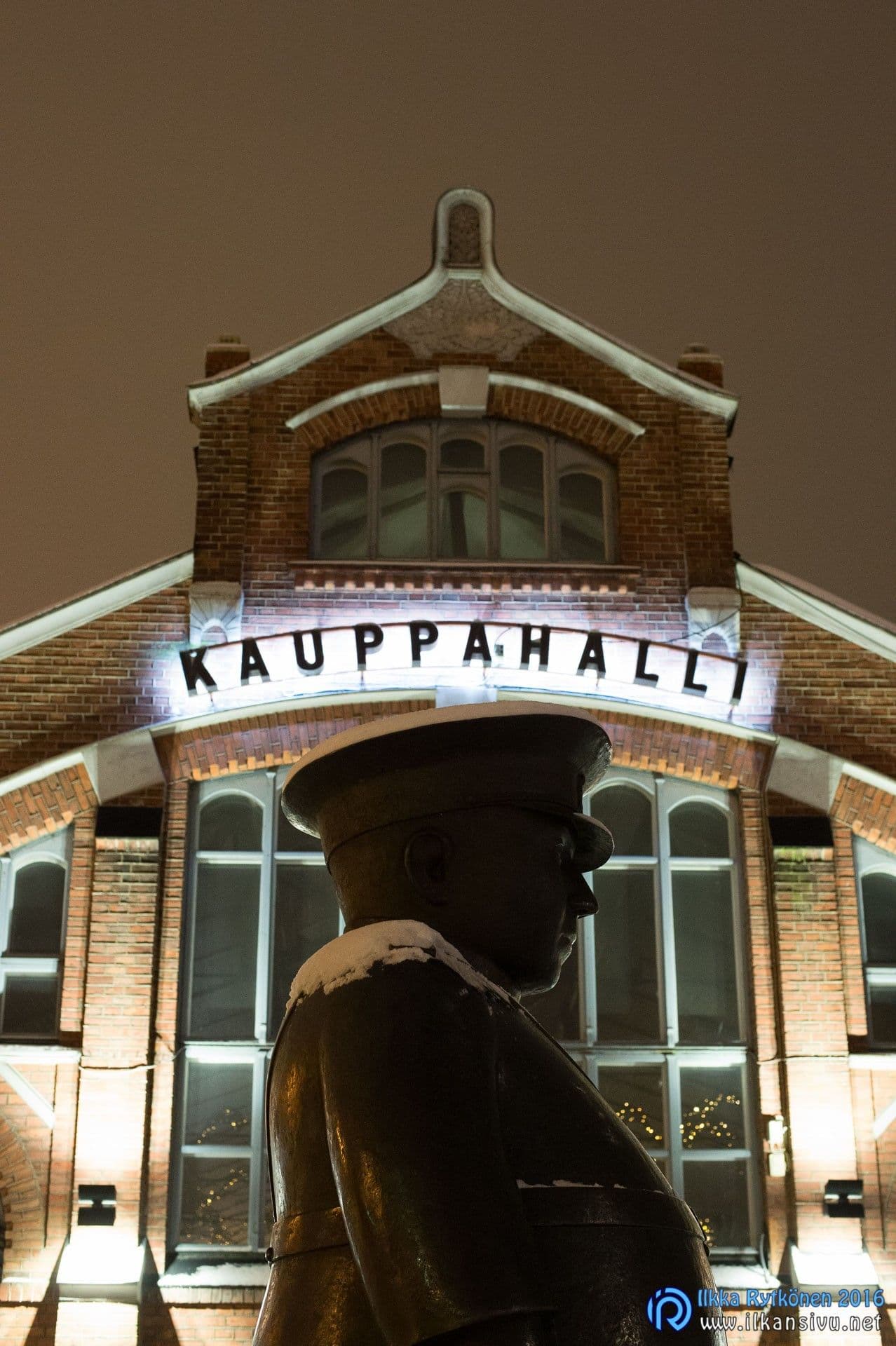

1/20 s, ƒ/5.6, ISO 6400 and the same image with the LR adjustments highlight -100, shadows +100.
Nikkor AF-S 50mm f/1.8G Special Edition
The 50mm lens that comes with the package is the same one that is also sold separately, with a more modern look, for a price of a couple of hundred euros. The price already tells that this does not represent the best of the Nikkors. The price does match the quality, though, so this lens is a good purchase for a photographer on a small budget. A plastic lens hood is included in the sales package.
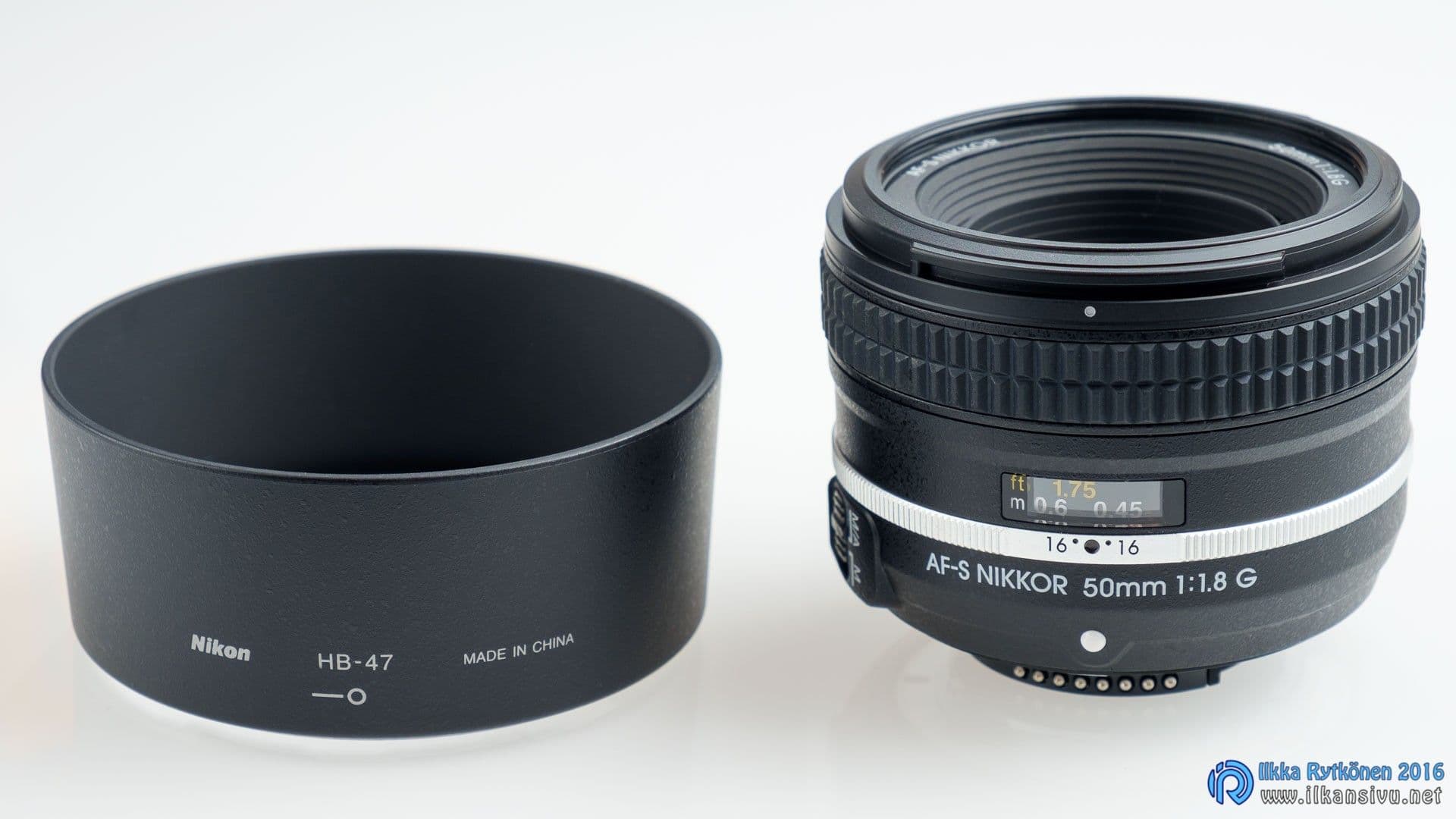
The lens has two controls, the autofocus/manual focus switch and the focus adjustment. The travel of the focus ring is about a quarter turn from one extreme to the other, so this is no dream for a manual-focus shooter.
In good light the focus works quickly and silently with the Df, assisted by the SWM motor. In dimmer light the focus slows down clearly.
The lens has slight barrel distortion. Vignetting is strong at large apertures, but decreases steadily when stopping down, as far as f/2,8. The budget Nikkor tolerates backlight nicely.
At f/1,8 the lateral chromatic aberration already jumps out from the preview image, and there is also longitudinal aberration. The aperture f/2,8 already evens things out nicely, and the image starts to be clean from f/5,6 onward.
Sharpness and contrast are not at their best at the largest aperture, even in the center of the frame. Stopping down by one stop clearly improves the center, but the edges still stay rather soft.
The edges begin to look better from approx. f/5,6 onward. Sharpness keeps improving when stopping down to somewhere around f/8 and f/9, but when stopping down further the image begins to turn soft again. F/16 corresponds roughly to f/3,2 in softness, but at the smallest aperture the contrast seems to be worse.

All in all the lens leaves something to be desired, but for 200 euros you get a 200-euro lens, and compared to that this one is decent. On the other hand, if you are not going to nitpick over pixels, then the quality is excellent for smaller prints, web use and many other things.
Conclusions
The Nikon Df is a camera for someone who is not satisfied with the ordinary. The camera's user interface and looks make it different from modern cameras. Inside, however, there is sound technology in its own right, so the camera certainly has what it takes to go a long way.
With the 50 mm lens the price is approx. 3000 euros, which is a lot of money. For the same price you can get, for example, the D810, which contains one of the best, if not the best, full-frame sensors and is also in other respects the best of Nikon. But the other Nikons then look dull and ordinary next to this one. Shooting with the Df is fun!
Shooting with the Df is fun!
The standard lens that comes with it is not the highest-quality option for this camera. If you want to get more out of this camera, that means buying a higher-quality lens, unless you happen to have one in your bag already.